 by
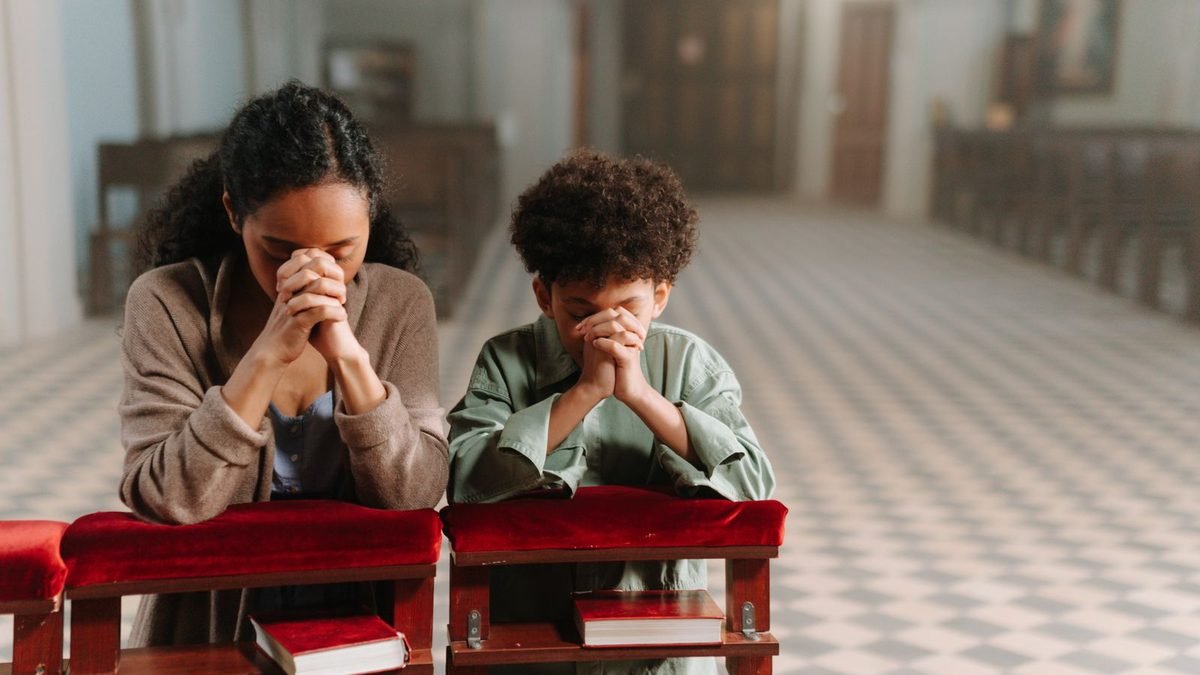
Morning prayers Catholic families actually keep are rarely the ones in the picture books. There is no quiet chapel, no unbroken silence, no child sitting still with folded hands for twenty minutes. There is a kettle, a school bag with one shoe missing, a phone already buzzing, and about nine minutes before everyone has to leave the house. And still — still — the day can begin with God in it.
I know this because I have tried both versions. The grand version, where I set the alarm an hour early and planned a whole Rosary before breakfast, lasted about four days. The small version — one prayer at the kitchen table, one at the door, one in the car — is still going. Morning prayers Catholic parents pass on to their children are not usually impressive. They are repeatable. That is the whole secret, and it is the subject of this page: ten prayers, fitted to real mornings, that a busy Catholic family can actually pray, day after day, without pretending life is tidier than it is.
Below you will find the ten prayers in full — the Morning Offering, the Guardian Angel prayer, the Our Father, the Hail Mary, the Glory Be, a decade of the Rosary, a family prayer, a prayer for work and school, a prayer for the mornings when prayer feels dry, and a closing blessing — each one placed inside a small habit, with honest answers for the problems that usually kill a morning routine: no time, noisy children, tiredness, distraction, guilt, and the feeling that you are doing it wrong.
For the traditional prayers themselves, see Catholic Morning Prayers.
What Morning Prayers Catholic Families Really Look Like
Let me clear away the picture in your head first, because it does more damage than any busy morning ever will. The Catholic Church does not ask you to pray like a monk before breakfast. It asks you to begin the day with God. Those are very different things. Beginning the day with God can mean a full Rosary in a quiet house. It can also mean a Morning Offering said with your eyes still half shut, your feet on a cold floor, while the toast is burning.
The tradition is old and simple. Catholics have begun the day for centuries by offering it to God, greeting their guardian angel, and praying the words Jesus taught us. The prayers are short on purpose. The Church knew — long before school runs and shift work — that mornings are the most interrupted part of the day. That is why the Morning Offering takes less than a minute, and why the Guardian Angel prayer is four lines long. They were made for people with things to do.
So if your morning prayer has ever felt too small to count, hear this plainly: it counts. A prayer said at the sink, with a child shouting for a PE kit, is still a prayer. God is not grading your performance. He is listening for your voice, first thing, before the world gets the rest of you. The habit matters — but not in the way you might fear. It matters because a day that starts with God is carried differently, even when nothing else about the day changes. The traffic is still slow. The meeting is still difficult. But you walk into it already held, instead of walking into it alone and hoping for the best.
A word about guilt, since it is the reason most family prayer routines die. You will miss mornings. You will forget, sleep through the alarm, or lose the whole thing to a spilt bowl of cereal. That is not failure; that is family life. The Catholic answer to a missed morning is not a lecture, it is Confession’s gentler cousin: begin again tomorrow. Saints became saints by beginning again, not by never missing a day. Keep the routine small enough to return to, and it will survive the weeks when everything else falls apart.
Morning Prayers Catholic Habit 1: Offer the Day Before Anything Else
The first habit is the foundation, and it takes less than sixty seconds. Before the phone, before the news, before the first email — offer the day to God. This is the Morning Offering, the most characteristic of all morning prayers Catholic families pray, and it is the single best place to start if you are starting from nothing.
Prayer 1 — The Morning Offering
“O Jesus, through the Immaculate Heart of Mary, I offer You my prayers, works, joys, and sufferings of this day for all the intentions of Your Sacred Heart, in union with the Holy Sacrifice of the Mass throughout the world, for the salvation of souls, the reparation of sins, the reunion of all Christians, and in particular for the intentions of the Holy Father this month. Amen.”
Read it slowly the first few mornings, and do not worry about memorising it perfectly. The words are doing something even while you are still learning them: they hand the day over before the day has a chance to take itself from you. Work, family, health, worries, the small frustrations you cannot yet see coming — all of it is offered, all at once, in one breath.
Here is the problem this habit solves: most of us start the day by handing it to someone else first. The phone gets the first minute. The news gets the first mood. The inbox gets the first decision. By nine o’clock we feel owned by the day, because we gave it away before we were properly awake. The Morning Offering reverses that order. God gets the first minute, and everything after it is borrowed from Him rather than stolen by the world.
How to make it stick when you are half asleep: say it in the same place every morning. Sitting on the edge of the bed works. Standing at the kettle works. I say mine with my feet on the floor and my eyes still closed, before my feet have decided whether they are ready for the day. Keep a printed copy beside the bed for the first two weeks. After that, your mouth will know it before your brain does. If the full wording feels too long on a rushed morning, the short form still counts: “Lord, I give You this day, and everything in it.” Say that, mean it, and go.
One more practical point. If you are the parent, say the Offering out loud where your children can hear it, at least sometimes. Children learn prayer the way they learn language — by hearing it used, casually, every day, by the people they love. You do not need to make them repeat it. Hearing it is enough for now. Years from now, they will find those words in their own mouth on a morning when they need them, and they will not remember where they learned them. They learned them from you, at the kitchen table, on an ordinary Tuesday.
Morning Prayers Catholic Habit 2: Greet Your Guardian Angel at the Door
The second habit belongs to the doorway, not the bedroom. Catholics believe God gives each of us a guardian angel, and the morning is the time to greet him and ask for his help — not as a decoration on a holy card, but as a real companion for a real day of roads, classrooms, offices and waiting rooms.
Prayer 2 — The Guardian Angel Prayer
“Angel of God, my guardian dear, to whom God’s love commits me here, ever this day, be at my side, to light and guard, to rule and guide. Amen.”
Four lines. Children can learn it in a week, and adults who have not prayed it since childhood will find it comes back like a song they thought they had forgotten. Pray it as you leave the house, or before the children leave for school, or in the car before you turn the key. It is a prayer of trust: you are not walking into the day alone, and God’s care is personal, constant and close.
This habit solves a very specific problem — the worry that starts the moment the front door closes behind your children. Every parent knows it: the small, cold thought as they turn the corner, the “what if” that follows you all the way to work. You cannot watch them all day. You were never meant to. The Guardian Angel prayer is how a Catholic parent hands that worry to someone who can watch them all day. Say their name in your heart as you pray it. “Angel of God, be at her side today.” Then go to work. You have done what you could do, and you have asked Heaven to do the rest.
Make it a doorway habit and it will keep itself. Tape a small card beside the front door, at the children’s eye level. Let the last thing anyone does before leaving be the prayer, not the hunt for a lost shoe — though in real life it will often be both, in that order. On the days when everything is running late and tempers are short, a four-line prayer is still possible. That is the point. A routine that only works on calm mornings is not a routine; it is a decoration. This one works on the worst morning of the week, because it is short enough to survive it.
For older children and teenagers, do not force it. A teenager who is made to recite a prayer at the door will resent the prayer and the door. Pray it yourself, out loud, as you lock up. Let them hear it without being tested on it. Faith caught is stronger than faith enforced, and a prayer overheard every morning for ten years does quiet work that no lecture can match.
Morning Prayers Catholic Habit 3: Three Short Prayers That Anchor the Morning
If the Morning Offering gives the day away, these three prayers anchor it. The Our Father, the Hail Mary and the Glory Be are the foundation of almost all Catholic prayer: the words Jesus Himself taught us, the greeting of the angel to Mary, and the Church’s ancient praise of the Trinity. Prayed slowly, they take about two minutes. Two minutes is a price almost any morning can pay.
Prayer 3 — The Our Father
“Our Father, who art in heaven, hallowed be thy name; thy kingdom come; thy will be done on earth as it is in heaven. Give us this day our daily bread; and forgive us our trespasses as we forgive those who trespass against us; and lead us not into temptation, but deliver us from evil. Amen.”
Prayer 4 — The Hail Mary
“Hail Mary, full of grace, the Lord is with thee. Blessed art thou among women, and blessed is the fruit of thy womb, Jesus. Holy Mary, Mother of God, pray for us sinners, now and at the hour of our death. Amen.”
Prayer 5 — The Glory Be
“Glory be to the Father, and to the Son, and to the Holy Spirit. As it was in the beginning, is now, and ever shall be, world without end. Amen.”
Notice what these three prayers do together. The Our Father places you as a child before God, and asks for bread, forgiveness and protection in a single breath. The Hail Mary places you under Our Lady’s care, and asks her to pray for you now and at the hour of your death — which is another way of saying, at this hour and at the last one. The Glory Be lifts your eyes to the Trinity, and reminds you that the God you are talking to was here before the morning began and will be here after it ends. Bread, protection, praise: a whole morning, in three short prayers.
The problem these three solve is the feeling of not knowing what to say. New Catholics, returning Catholics, and tired parents at six in the morning all share the same blank moment: “I want to pray, but the words won’t come.” These prayers are the answer the Church gives you. You do not need your own words. These are the Church’s words, prayed by millions of people this morning, in every language, in kitchens and hospital wards and buses all over the world. When you pray them, you are not praying alone. You are joining a conversation that never stops.
A practical way to pray them with children: give each child one prayer. The youngest gets the Glory Be, because it is the shortest. The middle one gets the Hail Mary. You take the Our Father. Rotate them on Sundays. Within a month, a five-year-old will know a prayer by heart without a single lesson, and a ten-year-old will have three. That is catechesis, and it happened before breakfast, without anyone calling it catechesis.
If you have time for nothing else all morning — not the Offering, not the Rosary, not a single quiet minute — pray these three. It takes two minutes, and it places the whole day under God’s care. For more encouragement in Scripture, read Good Morning Bible Blessings.
Habit 4: One Decade of the Rosary, Not All Five
Here is where most Catholic morning routines quietly die: the Rosary. People hear “pray the Rosary in the morning” and picture twenty minutes of uninterrupted beads, and since twenty uninterrupted minutes do not exist in their house, they pray nothing at all. The fix is simple, and the Church has always allowed it: pray one decade, not all five.
Prayer 6 — A Decade of the Rosary, ending with the Hail Holy Queen
Begin with the Sign of the Cross. Announce the mystery for the day — joyful on Monday and Saturday, sorrowful on Tuesday and Friday, glorious on Wednesday and Sunday, luminous on Thursday. Pray one Our Father, ten Hail Marys and one Glory Be, thinking about that mystery as you go. Then, if you like, finish with the Hail Holy Queen:
“Hail, Holy Queen, Mother of Mercy, our life, our sweetness and our hope. To thee do we cry, poor banished children of Eve. To thee do we send up our sighs, mourning and weeping in this valley of tears. Turn then, most gracious Advocate, thine eyes of mercy toward us, and after this our exile, show unto us the blessed fruit of thy womb, Jesus. O clement, O loving, O sweet Virgin Mary. Pray for us, O Holy Mother of God, that we may be made worthy of the promises of Christ. Amen.”
One decade takes about four minutes. Four minutes fits into the life you actually have: while the kettle boils, while the porridge thickens, while the children are looking for their bags and you are standing still for the only still moment of the morning. Keep the beads by the kettle, not in a drawer upstairs. The beads you can reach are the beads you will use.
The mystery matters more than the speed. Do not race through ten Hail Marys like a shopping list. Take one scene — the Annunciation on a Monday, the Crucifixion on a Friday, the Resurrection on a Sunday — and hold it in your mind while your fingers move. If your mind wanders to the packed lunches, bring it back gently, without scolding yourself. A wandering mind brought back ten times is a prayer, not a failure. The saints wrote about this constantly, because it happened to them too.
What about the rest of the Rosary? Pray another decade at lunchtime, one on the school run, one while you wait for the bus. The Rosary was never meant to be an exam you pass in one sitting. It is a rope you can pick up and put down all day, and the morning decade is simply the first length of it. On Saturdays, when the house is slower, you may find the whole Rosary comes easily. On Mondays, one decade is a victory. Both count the same in Heaven, because Heaven counts the love, not the length.
Habit 5: Praying With Children Without a Morning Battle
This is the habit parents ask about most, and the one most often abandoned. How do you pray with children in the morning without it becoming a battle — without the eye-rolls, the fidgeting, the “do we have to”, and the whole thing collapsing before the toast is done? The honest answer is: you make it shorter, earlier, and more ordinary than you think it should be.
Prayer 7 — A Family Prayer for the Morning
“Heavenly Father, bless our family this morning. Protect our children on their way to school, watch over us at work, and keep our home safe while we are away. Fill our house with patience, kindness and understanding. Where there has been tension, bring healing. Keep us safe today, and bring us all home safely tonight. Through Christ our Lord. Amen.”
Pray it at the breakfast table, standing up, before anyone leaves. One minute, all together, and then the day starts. Do not ask for silence first. Do not wait for perfect stillness. Say it over the clatter, in the middle of the ordinary noise, and let the children hear that prayer belongs in real life, not only in church.
Three things make this work where longer family prayers fail. First, keep it to one prayer. Children can hold one prayer. They cannot hold a liturgy before school. Second, let them own a piece of it. One child says the Guardian Angel prayer, another names who we are praying for today — gran, a sick friend, a test at school. A child who has a job in the prayer is a child who stays for the prayer. Third, never use prayer as a punishment or a lecture. The moment morning prayer becomes “sit down and pray because you were naughty”, it is finished for years. Prayer is the kindest part of the morning, not the strictest.
For very small children, keep it physical: hands together, eyes open is fine, one short line they can say with you — “Angel of God, be at my side today.” A three-year-old saying one line, every day, is praying. Do not measure their prayer by adult standards. God does not.
For teenagers, the rule changes completely: do not force it, and do not test them on it. Pray the family prayer yourself at breakfast, out loud, whether they join in or not. Offer them the one job that teenagers will sometimes take — choosing the intention for the day. “Who shall we pray for today?” is a question, not a command, and questions leave the door open. Some mornings they will answer. Some mornings they will not. Both are fine. What they remember, years later, is not whether they joined in. It is that prayer happened in their house, every morning, like breakfast — ordinary, expected, and never used against them.
And if the whole thing falls apart — the baby cries, the toast burns, someone is already crying about a lost shoe — then the prayer for that morning is the shortest one there is: “Lord, help us.” Said with a real heart, in the middle of the mess, that is a family prayer too. God is not waiting for the perfect setting. He is waiting at the breakfast table, in the middle of it all.

Habit 6: Work, School and the People You Love
A Catholic morning is not only about your own soul. The people you love leave the house and go into places you cannot follow — classrooms, offices, wards, building sites, motorways. Morning prayer is how you go with them anyway, in the only way that actually reaches them.
Prayer 8 — A Prayer for Work, School and the Day Ahead
“Lord, bless the work of our hands today. Give us wisdom in every decision, honesty in every dealing, and kindness in every conversation. Help us to do our work well, as if we were doing it for You. Protect our children at school and our family at work. Help us finish what matters, and let go of what can wait until tomorrow. Through Christ our Lord. Amen.”
Name each person as you pray it. Not a long list — just their names, held before God for a second each. “Mum. Dad. Sophie. The new boss. Mrs. Patel’s class.” Naming is the oldest form of prayer there is, and it changes the prayer from a general wish into something personal. Your children, hearing their own names in your morning prayer, learn something no lesson can teach: that they are carried, every day, by someone who talks to God about them.
Work, in Catholic teaching, is not separate from faith. God is served at the desk, on the ward, at the kitchen table, on the building site — wherever your hands are busy. Offering your work in the morning turns even a long, dull shift into an act of prayer. That does not make the shift shorter. It makes it meaningful, which is a different and better thing. If you are facing a hard meeting, an interview, a difficult conversation with a colleague, pray this prayer again before you walk in. God goes before you into rooms you have never entered.
School deserves its own mention, because school mornings carry their own particular fear. A child walking into a playground with a worry — a test, a friendship gone wrong, a teacher they are afraid of — needs more than “have a good day”. Pray for the specific thing. “Lord, be with her in the test. Give him a kind friend today.” Then, when they come home, ask how it went. The prayer and the question belong together. A child who knows they were prayed for in the morning walks into school a little taller, even if they would never admit it.
And for the parent working nights, or on a shift that starts before dawn: your morning may be someone else’s midnight. The prayers do not care what the clock says. Pray them when you wake, whenever that is. The Morning Offering said at 4 a.m. before a night shift is the same prayer, offered by the same Church, to the same God. He keeps different hours than your employer.
If you need strength for a hard day, Morning Prayers for Strength and Courage offers more prayers for exactly that.
Habit 7: When Prayer Feels Dry, Distracted or Rushed
Sooner or later — usually in the second week — the morning prayer goes dry. The words feel empty. Your mind wanders to the shopping list. You say the Hail Mary and realise halfway through that you have been thinking about the car insurance. You wonder if you are doing it wrong, or if God has stopped listening, or if you ever really believed any of this at all.
Prayer 9 — A Prayer for Dry and Distracted Mornings
“Lord, I do not feel much this morning, and my mind will not stay still. I offer You this prayer anyway — the words, the wandering, the tiredness and all. Stay with me through this day, even when I cannot feel You near. Teach me to be faithful when I am not inspired, and to trust that You hear me even when my heart is quiet. Amen.”
This is the most important prayer on this page, because dryness is where most people quietly give up. So hear the truth the saints repeat in every century: dryness is normal, distraction is normal, and a prayer said without feeling is still a prayer. Feelings are weather. Faith is the house. The house stands in bad weather too.
Three practical fixes, each one small. First, shorten the prayer on dry days, do not lengthen it. A tired, distracted person who forces a long prayer will only learn to hate prayer. One Hail Mary, said slowly, is better than a Rosary said in resentment. Second, pray out loud when your mind wanders. Your own voice is an anchor; it is much harder to think about car insurance while your mouth is saying the words. Third, change the place. If the kitchen table has gone stale, pray by the window, in the car, or walking to the bus stop. A new place wakes up an old prayer.
Distraction has a second face that is worth naming: the phone. The phone is the single greatest enemy of Catholic morning prayer in our time, and it wins by being first. It is in your hand before your feet touch the floor. The fix is boring and it works: charge the phone outside the bedroom. Put the alarm clock back on the bedside table, and let the first thing your hand touches in the morning be a prayer card, not a screen. Families who try this for one week almost never go back. The morning feels longer, quieter, and strangely your own again.
And guilt? Guilt after a dry morning, or a missed morning, or a morning ruined by shouting, is the oldest trick in the book. It tells you that because the prayer was imperfect, it did not count, and because it did not count, you might as well stop. That voice is not God. God’s voice sounds like this: begin again tomorrow. Go to Confession when you need to, receive the sacraments, and begin again. The Catholic life is not a streak to protect. It is a relationship to return to, as many times as it takes.

Habit 8: A Family Morning Routine That Survives Real Life
A routine that only works on good days is not a routine. Here is one that has survived school mornings, night shifts, sick days and holidays in my own house, and it takes about ten minutes. It is built to bend, not break.
Step 1 — Wake five minutes earlier than you must. Not an hour. Five minutes. Sit up, make the Sign of the Cross, and thank God for the new day. Those five quiet minutes, before the house wakes, can change the whole morning.
Step 2 — Pray the Morning Offering (Prayer 1). The foundation. If you do nothing else all morning, do this. It takes less than a minute and it gives the day away before the world can take it.
Step 3 — Pray the three short prayers (Prayers 3, 4 and 5). One Our Father, one Hail Mary, one Glory Be. Two minutes. If the children are up, let them join in for these — they are the easiest to learn and the hardest to forget.
Step 4 — Read one verse slowly. Psalm 118:24 is a good place to start: “This is the day the Lord has made; let us rejoice and be glad in it.” Read it aloud. Let the words settle. If you need a prayer for any day, begin with A Good Prayer for Today.
Step 5 — One decade of the Rosary (Prayer 6), or one short prayer if there is no time. The decade is the goal; the short prayer is the fallback. Both are fine. A routine with a fallback is a routine you will keep.
Step 6 — The family prayer (Prayer 7) at the table, and the Guardian Angel prayer (Prayer 2) at the door. Then go gently into the day.
Prayer 10 — A Closing Blessing for the Week Ahead
“May the Lord bless you and keep you this morning. May He give you strength for your work, peace for your heart, protection for your family, and joy for your home — today, and all the days of this week. May Our Lady watch over you, may your guardian angel walk beside you, and may you go into this day knowing you are loved, you are not alone, and God goes with you. Amen.”
Keep the routine the same every day for a month before you change anything. Same prayers, same order, same place. Repetition is not boring to a child, or to a tired adult — it is restful. It means you do not have to decide anything at six in the morning. You just begin, and the prayers carry you.
When the routine breaks — and it will, on the morning of the dentist appointment, the morning the car will not start, the morning someone is ill — do not rebuild it from scratch. Just do Step 1 and Step 2 the next day. The Offering and the Sign of the Cross are the whole routine in miniature. Everything else is built on top of them, and everything else can wait until tomorrow.
Five one-line prayers for the car and the school run, when even the routine will not fit:
- Lord, I offer You this day, and everything in it.
- Jesus, I trust in You.
- Holy Mary, Mother of God, pray for us this morning.
- Angel of God, be at my side today.
- Come, Holy Spirit, fill my heart and guide my day.
Keep one beside your bed, or stuck to the dashboard. A short prayer, prayed with a sincere heart, is worth more than a long prayer rushed through without attention. If you need prayers for a hard or hurting morning, Morning Prayers for Healing and Peace is there for that too.

Morning Prayers Catholic: Frequently Asked Questions
What are morning prayers Catholic families should start with?
Start with the Morning Offering. It takes less than a minute, it is the most characteristic Catholic morning prayer, and it gives the whole day to God before anything else happens. Add the Guardian Angel prayer at the door, and the Our Father, Hail Mary and Glory Be when you have two more minutes. That is a complete Catholic morning. Everything else — the Rosary, the saints, a longer routine — is built on top of those, not instead of them.
How long should Catholic morning prayers take?
One minute is enough for the Morning Offering and a Hail Mary. Ten minutes covers the Offering, the three short prayers, a decade of the Rosary and the family prayer. Do not measure the morning by the clock. Measure it by whether God was given the first word of the day. A short prayer said with a real heart is worth more than a long prayer said in a rush.
Can I pray the Rosary in the morning if I am short of time?
Yes. You do not need to pray all five decades at once. One decade — one Our Father, ten Hail Marys and a Glory Be — is a complete and beautiful morning prayer. Many Catholics pray one decade in the morning and the rest later in the day, on the school run, at lunchtime, or before bed.
Which saints should I pray to in the morning?
Begin with Our Lady, Saint Joseph and your guardian angel. Saint Joseph is the patron of workers, so he is a natural companion before work: “Saint Joseph, patron of workers, pray for us.” Saint Michael the Archangel is the protector to call on when the day ahead feels frightening: “Saint Michael the Archangel, defend us in battle.” Over time, add the patron saint of your profession, your parish, or your own name — and greet them each morning, the way you would greet a friend who is already praying for you.

Closing Blessing
“May the Lord bless you and keep you this morning. May He give you strength for your work, peace for your heart, protection for your family, and joy for your home. Go into this day knowing you are loved, you are not alone, and God goes with you. Amen.”
When you begin the day with God, you do not face it alone — and the day, whatever it holds, already belongs to Him. Start small, start tomorrow, and begin again as many times as it takes. That is how a Catholic family prays in the morning: not perfectly, but faithfully, one ordinary day at a time.